Affordable Group Buy Service
200+ Premium Tools Service
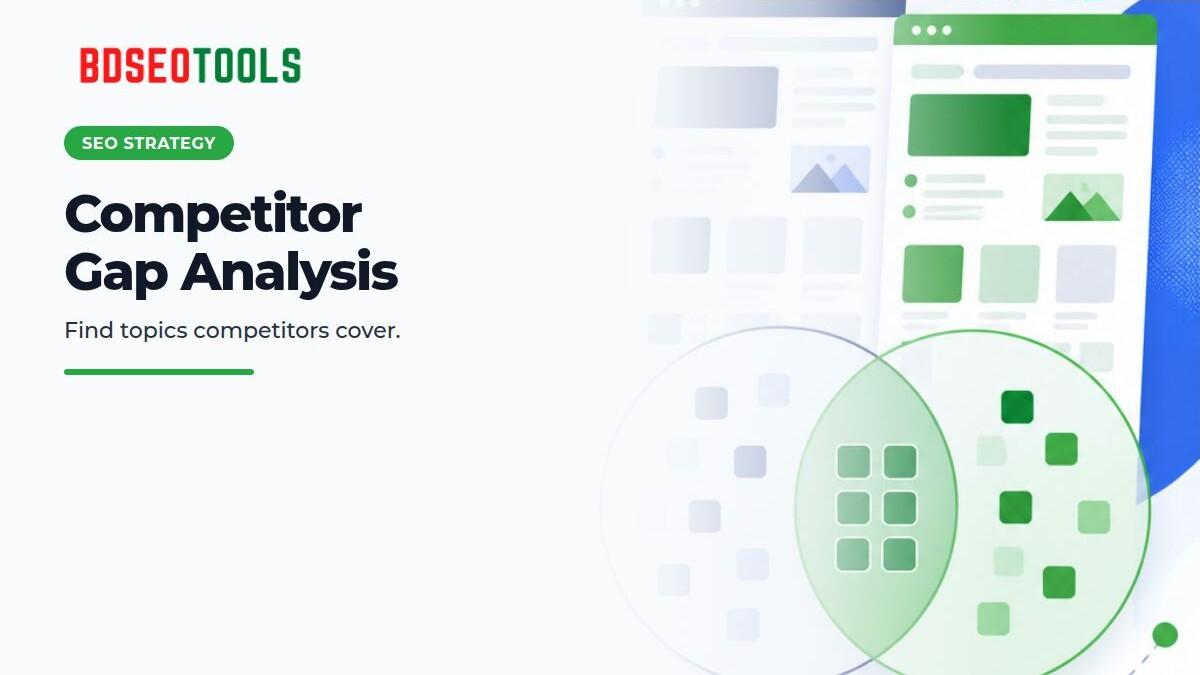
Competitor gap analysis identifies queries, questions, or tasks that competing search-result pages cover but your site does not. It is not a shortcut to “easy rankings.” The goal is to find a genuine content opportunity that helps your audience and relates to your business or expertise.
Choose search competitors carefully
Your business competitors and search competitors are not always the same. For a particular query, Google may show publishers, marketplaces, forums, official product pages, or local providers. Search a handful of queries yourself rather than starting only from a familiar list of companies.
- Compare results for the same audience and market; separate Bangladesh-specific intent from other markets.
- Keep direct business competitors and SERP competitors in separate lists.
- Do not use a page that is absent from the search results as a keyword benchmark.
- Do not combine different result sets when they represent different intent.
Collect keyword and content gaps
Use a defined date range from your own Search Console data for queries, pages, clicks, impressions, CTR, and average position. Then compare ranking queries for selected competitor domains or pages in an SEO research tool. Do not treat tool estimates as equivalent to Search Console performance; databases and locations may differ.
Record these details for each possible gap:
- The query or topic and which pages currently appear in results.
- Search intent: informational, commercial, transactional, or local.
- Any existing page on your site that already addresses the topic.
- The answer, evidence, local detail, or experience that is missing.
- Business fit and the cost of creating or updating content.
Queries with similar intent can often be handled by one page. Do not create multiple thin articles just because the keyword variants differ.
Prioritize opportunities
Start by checking business fit and whether the content gap is real. Deprioritize topics unrelated to your product, lacking sources, or impossible to address without copying a competitor's user-specific experience. If an existing page receives impressions but has the wrong intent or an incomplete answer, updating it may be more sensible than creating a new URL.
- High fit: The audience's question directly relates to your expertise or offer.
- Clear gap: You can provide a more useful answer with sourced or local detail.
- Feasible: You can maintain the evidence, visuals, review, and future updates.
- Distinct page: Your site does not already have a page serving the same intent.
Keyword difficulty alone does not determine priority. Treat it as a tool estimate and review the actual SERP, domain strength, page type, and your available evidence.
Turn the gap into an article brief
Before outlining, note which questions the top search results answer. Look for unanswered follow-up questions instead of copying their headings or sentences. Include the primary query, audience, intent, answer-first introduction, section outline, primary sources, internal links, and update owner in the content brief.
The Bangladesh keyword research framework, SEO content brief template, and topic cluster guide can support this process. Add internal links only when they are relevant; think of them as reader navigation, not ranking claims.
To compare tool access through BDSEOTOOLS, see the Custom 10 Tools listing. Its product page lists ৳800 for 30 days; confirm which tools can be selected and the current terms before checkout. It does not guarantee a competitor database or ranking outcome.
FAQ
Does every competitor gap require a new article?
No. First check whether an existing URL already serves the same intent. If it does, update that page or improve its internal links. Create a new article only when the query cluster needs a distinct, useful page.
How many competitors should I compare?
There is no fixed number. Compare relevant search results and the market for each query. Adding unrelated large sites may make the gap list longer without making the action plan better.
Does a keyword difficulty score guarantee rankings?
No. It is a third-party estimate. Content quality, competition, site signals, query intent, and other factors can vary; no score guarantees rankings.
When should I repeat a gap analysis?
There is no mandatory interval. Update the analysis for a new content plan, major product change, or meaningful query shift in Search Console. Record the date range and comparison basis.